
hand and foot card game instructions
Love Hand & Foot? We've got the ultimate guide to rules, scoring, and tips to *dominate* your next game night! Learn to play like a pro.
Hand and Foot Card Game Instructions ─ Article Plan
Hand and Foot is a captivating card game for teams, blending strategy and luck across four rounds.
It’s similar to Canasta, requiring melding and skillful discarding.
This comprehensive guide will detail everything from setup, dealing, gameplay, scoring, and even common variations.
Hand and Foot is a dynamic and engaging card game, deeply rooted in North American card game traditions, and shares similarities with the classic game of Canasta. However, Hand and Foot distinguishes itself with a unique two-handed approach, adding a layer of strategic complexity. Players are initially dealt two sets of cards – the “Hand” and the “Foot” – requiring careful management and planning to effectively utilize both.
The game typically involves two teams competing to accumulate the highest score over four distinct rounds. It’s a game of melding, where players create combinations of cards, and skillful discarding, aiming to deplete their cards before opponents. While numerous variations exist, the core objective remains consistent: strategic card play and calculated risk-taking. Prepare for a challenging and rewarding card game experience!
Game Overview & Objective
Hand and Foot is a matching-type card game played with multiple decks, typically involving four to six players divided into teams. The central objective is to be the first team to empty their collective hands and feet of cards by strategically forming “books” – melds of at least three cards of the same rank.
Success hinges on skillfully melding cards, utilizing wild cards effectively, and managing both your hand and foot throughout the four rounds of play. Teams earn points for completed books and face penalties for unmelded cards remaining in their possession at the round’s end. The team with the highest cumulative score after all four rounds is declared the winner!
Number of Players & Teams
Hand and Foot is best enjoyed with either four or six players, organized into partnerships. When playing with four, two teams of two are formed, with partners seated opposite each other at the table. With six players, three teams of two compete. This team dynamic is crucial, as partners collaborate to meld cards and achieve a combined score.
While the game can technically be adapted for other player counts, these configurations are less common and may require adjustments to the dealing and scoring procedures; The core gameplay is designed around the cooperative element of two-person teams, fostering strategic communication and shared success.
Required Materials (Decks of Cards)
To play Hand and Foot, you’ll need a substantial number of standard playing cards. The exact quantity depends on the number of players, but a general rule is to use one complete deck (including Jokers) per player. Therefore, for a four-player game, you’ll require four decks of cards, and for six players, six decks are necessary.

Including Jokers is vital, as they serve as powerful wild cards throughout the game. Ensure all decks are thoroughly shuffled together before dealing to create a single, large card pool. Using multiple decks adds to the strategic depth and increases the opportunities for creating melds.
Card Values & Wild Cards
Understanding card values is crucial for successful gameplay in Hand and Foot. Standard cards – 2 through 9 – hold their face value in points. Ten, Jack, Queen, and King are each worth 10 points. Aces are typically valued at 20 points, contributing significantly to a player’s score when melded.
However, the true game-changers are the wild cards. Jokers are universally recognized as wild cards, capable of representing any other card to complete a meld. Their strategic use is paramount. Red threes and black threes also hold special value, often granting bonus points or penalties depending on the game’s specific rules.
Standard Card Values
In Hand and Foot, the numerical cards hold specific point values essential for scoring. Cards numbered 2 through 9 retain their face value – a 2 is worth 2 points, a 9 is worth 9 points, and so on. This straightforward valuation forms the base of your meld scoring.
Face cards – 10s, Jacks, Queens, and Kings – are consistently valued at 10 points each. Aces, however, carry a higher weight, typically worth 20 points. Strategically melding Aces can significantly boost your round score, making them valuable cards to collect and play.
Role of Jokers as Wild Cards
Jokers are incredibly versatile in Hand and Foot, functioning as powerful wild cards. They can substitute for any other card when forming melds, offering flexibility and aiding in completing books. However, their use isn’t without limitations; you generally cannot discard a Joker if you’ve already picked up your foot.
The strategic deployment of Jokers is crucial. While valuable, they also carry a hefty point penalty if left unmelded at the round’s end. Therefore, prioritize incorporating them into books whenever possible. Jokers elevate melds, but careful management prevents scoring deductions.
Dealing the Cards — Hand and Foot
The dealer distributes cards in Hand and Foot, initiating each round. Typically, each player receives two sets of eleven cards – the ‘hand’ and the ‘foot’. The number of decks used dictates the card count per player, scaling with the player number. All decks, including Jokers, are thoroughly shuffled before dealing.

Players carefully separate their cards into these two distinct piles: the hand, played first, and the foot, used only after the hand is exhausted. This separation is fundamental to the game’s structure. The dealer rotates clockwise after each round, ensuring fairness and varied gameplay.
Initial Deal — Number of Cards per Round
The initial deal in Hand and Foot involves distributing eleven cards to each player, forming two distinct sets: the ‘hand’ and the ‘foot’. This standard allocation applies across most variations, though adjustments can occur with house rules. The exact number of decks utilized directly influences the card distribution, ensuring sufficient cards for all players.
For games with four players, a minimum of four decks is recommended, while six players necessitate five or six decks. Each player receives their eleven cards, carefully separating them into the hand and foot piles. This initial deal sets the stage for strategic melding and gameplay throughout the round.
Separating Hand and Foot
After receiving the initial eleven cards, players meticulously separate them into two distinct piles: the ‘hand’ and the ‘foot’. The ‘hand’ is the first set of cards to be played, requiring strategic melding to deplete its contents. The ‘foot’ remains untouched until the entire hand has been exhausted, adding a layer of complexity to the gameplay.
Players should arrange these piles neatly in front of them, clearly distinguishing between the two. This separation is crucial, as players cannot access the foot until their hand is completely empty. Proper organization ensures a smooth and efficient game flow, preventing accidental plays from the wrong pile;
Gameplay ─ A Turn-by-Turn Breakdown
Each player’s turn begins by drawing two cards from the stock pile, or picking up the entire discard pile – a strategic decision with potential consequences. Following the draw, players have the opportunity to meld cards from their hand onto the table, forming books of matching ranks. Melding is key to reducing card count and progressing towards going out.
After melding, players must discard one card face-up onto the discard pile, ending their turn. Discarding strategically is vital, avoiding helpful cards for opponents and adhering to specific discard restrictions. This cycle of drawing, melding, and discarding continues until a player successfully empties both their hand and foot.
Melding — Creating Books
Melding in Hand and Foot involves creating “books” – sets of at least seven cards of the same rank. These books are laid down face-up on the table for all players to see. Wild cards, like Jokers, can substitute for natural cards within a meld, but books require a minimum number of natural cards.
Valid meld combinations include seven or more of a kind, or combinations utilizing wild cards. Players can add to existing books on the table, even those started by opponents, furthering strategic play. Successfully melding reduces the cards in your hand and foot, bringing you closer to ending the round.
Valid Meld Combinations
Valid meld combinations in Hand and Foot center around collecting cards of the same rank. A basic meld requires a minimum of seven cards. You can create pure books using only natural cards, or mixed books incorporating wild cards – Jokers are crucial for flexibility.
However, most books need at least three natural cards, limiting the number of wild cards used. Runs are not permitted; melds must be of the same rank. Players can strategically build upon existing melds, adding cards to their own or even opponents’ books, fostering dynamic gameplay and tactical card management.
Minimum Book Requirements
Hand and Foot demands strategic melding, and fulfilling minimum book requirements is vital for scoring. To successfully “go out,” a team must complete a minimum of three books – groups of seven or more cards. These books can be either clean (all natural cards) or dirty (containing wild cards).
At least one book must be clean to conclude a round. The specific number of books needed can vary based on house rules. Failing to meet these requirements results in point penalties, emphasizing the importance of careful card collection and strategic melding throughout the game.
Going Out — Ending a Round
Hand and Foot rounds conclude when a player successfully discards their final card after playing both their ‘hand’ and ‘foot’. However, simply emptying your cards isn’t enough! You must have met the minimum book requirements – at least three books, with one being clean – before going out is permitted.
Once a player goes out, the round immediately ends. Opposing teams tally penalties for unmelded cards remaining in their hands and feet. Strategic play involves balancing card melding with anticipating when to discard, aiming to go out before opponents accumulate substantial points.
Scoring — Calculating Points
Hand and Foot scoring centers around points earned from completed melds (books) and penalties for unmelded cards. Books of seven cards award points, with clean books (all one rank) yielding higher scores than mixed books. Red threes provide bonus points, while black threes carry a penalty if held at round’s end.
Points are tallied after each round, and the team with the highest cumulative score after four rounds wins. Unmelded cards incur penalties, deducted from the team’s total. Accurate scoring is crucial, demanding careful attention to card values and book combinations.
Points for Melds (Books)

Hand and Foot melds, known as “books,” are the primary source of points. A standard book of seven cards earns 500 points. However, “clean” books – all cards of the same rank – are worth a substantial 1000 points. Wild cards within a book don’t diminish its value, but too many can hinder going out.
Red threes, when melded, grant a bonus of 100 points each, while black threes, though not penalized when melded, don’t contribute to the book’s base score. Strategic melding focuses on creating clean books for maximum points, balancing risk and reward.
Penalties for Unmelded Cards
Hand and Foot imposes penalties for cards remaining unmelded when a player goes out. Standard cards carry a negative value of 5 points each. Wild cards, including jokers, incur a hefty penalty of 25 points apiece. Red threes, if held at the end of a round, result in a significant deduction of 100 points each.
Black threes, while not scoring positively when melded, also carry a 5-point penalty if unmelded. Minimizing unmelded cards is crucial; strategic discarding and efficient melding are key to avoiding substantial point deductions and maximizing your final score.
The Four Rounds of Play
Hand and Foot unfolds across four distinct rounds, each increasing in complexity and point value. The first round utilizes a single deck of cards. Subsequent rounds progressively add decks – two for round two, three for round three, and finally, four or five decks for the concluding round.
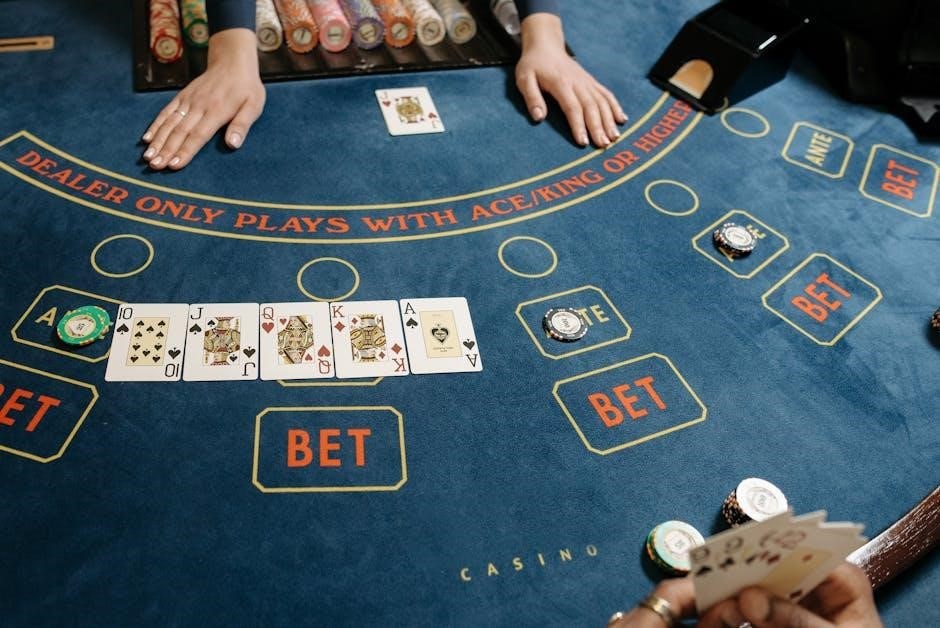
Each round demands players to deplete both their ‘hand’ and ‘foot’ through strategic melding. The increasing number of decks introduces more cards and potential melds, but also heightens competition. Scoring escalates with each round, making the final round particularly critical for securing victory.
Red Threes & Black Threes ─ Special Cards
Red threes are instant bonuses! When played, immediately collect 100 points, adding to your team’s score. They can be melded individually or as part of a larger book. Black threes, however, act as blockers. They prevent opponents from picking up the discard pile, offering a tactical advantage.
These cards introduce an element of surprise and strategic depth. Savvy players utilize red threes for quick points, while deploying black threes to disrupt opponents’ plans. Managing these special cards effectively is crucial for maximizing your score and hindering your rivals’ progress throughout the game.
Picking Up the Pile — When and How
Picking up the discard pile is a powerful move, but requires specific conditions. You can only do so if you can meld the top card of the pile with cards from your hand and have at least two natural cards (non-wild) already melded. This prevents opportunistic grabs without established plays.
To pick up, you must take the entire pile, adding it to your hand. Black threes within the pile block this action unless you can play them immediately. Successfully picking up the pile can significantly accelerate your melding process and put you closer to going out.
Discarding Rules & Restrictions
Discarding is a crucial element of strategy in Hand and Foot. Players must end their turn by discarding one card face-up onto the discard pile, initiating the next player’s turn. However, certain restrictions apply to maintain game balance.
Generally, you cannot discard a wild card (Joker) unless absolutely necessary, and even then, it’s often a risky move. Once a player has played their ‘foot’, discarding the final card becomes prohibited. This forces strategic play to deplete your hand and foot effectively. Careful consideration of discards can hinder opponents and protect your melds.
Common Variations & House Rules
Hand and Foot boasts numerous variations, making each game unique! Many groups establish ‘house rules’ to tailor the experience. Some allow discarding the last card after playing the foot, adding a layer of risk. Others modify scoring for red and black threes, increasing their value or introducing penalties.
Variations also exist regarding the minimum book requirements or the number of decks used. Some players implement stricter rules about picking up the pile, while others allow picking with specific cards. Agreeing on these variations before starting ensures fair play and a fun, customized game for everyone involved.
Strategic Tips for Winning
Hand and Foot success hinges on strategic card management. Prioritize melding quickly to reduce your hand size and open opportunities. Conserve wild cards for crucial melds or to prevent opponents from going out. Pay close attention to discards – deduce what cards your opponents need and avoid aiding them!
Effective teamwork is vital; communicate with your partner about your holdings and desired melds. Don’t be afraid to pick up the pile strategically, even with a penalty, if it contains valuable cards. Finally, remember to balance building books with preparing to play your foot – timing is everything!
Frequently Asked Questions (FAQ)
Q: How many decks are needed? A: Typically, five to six decks are used, including Jokers, depending on the number of players. Q: Can I discard a wild card? A: Generally, no, you cannot discard a wild card unless absolutely necessary; Q: What if I can’t meld? A: You must pick up the pile, even if it incurs a penalty.
Q: Is it okay to have house rules? A: Absolutely! Many groups enjoy customizing rules. Q: What happens if the deck runs out? A: Reshuffle the discard pile (excluding any cards already melded). Q: Can I play my foot before my hand? A: No, you must completely play your hand first.